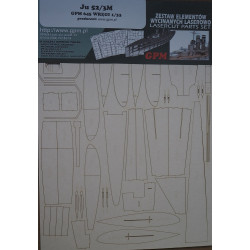
Publisher/ manufacturer: “GPM”. Poland
Scale: 1 : 33
Number of sheets: 17 x A3
Number of sheets with parts: 12 1/6
Number of assembly drawings: 74
Difficulty level: For average experience and experienced modelers
Dimensions of the model: 572,5 mm x 886,5 mm x 185 mm
 Security policy
(edit with the Customer Reassurance module)
 Delivery policy
(edit with the Customer Reassurance module)
 Return policy
(edit with the Customer Reassurance module)
The Junkers Ju-52 was a German three-engine low-wing bomber and transport monoplane with a classic all-metal construction tail. The single-engine prototype version first flew in 1930, and the first three-engine version (Ju52/3m) took off a year later. Initially, the Ju-52 was used by "Lufthansa" as a passenger and transport aircraft, but in late 1933 a long and fruitful military career began. Initially, from 1933 to 1935, the Ju-52 operated as a "replacement bomber" until the Luftwaffe received the modern He-111 and Do-17. It also saw combat in the Spanish Civil War. Initially, it served as a day bomber, but later - from 1937 - was mainly used as a transport aircraft. In the September Campaign, it also performed two functions - transport and bomber. However, in 1940-1945, the main tasks of these aircraft were only transport and medical. It was the Ju-52, that was the transport aircraft for German paratroopers in Crete in 1941, they also towed gliders attacking Fort Eben-Emael in 1940. Widely used in North Africa and on the Eastern Front. It was the Ju-52, that created air bridges for German units, surrounded in boilers near Demiansk and Stalingrad. The most common engine, depending on the version, was the Pratt-Whitney "Hornet", developing 600 h. p. power, or the BMW 132, reaching 830 h. p. The Ju-52 was a solid machine, easy to control, very reliable and cheap to produce. They received great recognition from pilots and were nicknamed "Tante Ju" (German: Aunt Ju). The last Ju-52 was withdrawn from Swiss aviation only in the early 1970s! Technical data: length: 18.9 m, wingspan: 29.24 m, height: 4.65 m, maximum speed: 265 km/h, climb rate: 2.9 m/s, maximum flight range: 1000 km, maximum ceiling 5900 m, armament: permanent - from 1 to 3 7.92 or 13 mm caliber machine guns, hanged - up to 1500 kg of bombs.
A well-designed, richly detailed and quite complex aircraft model for medium-experienced and experienced modelers - even for them it will not be an "easy walk". The model has excellent detailing of the cabin and transport compartment interior, landing gear, engines and their gondolas, external detailing. The model is painted in standard German broken-spot camouflage and recreates the appearance of a medical aircraft, used in the Crete landing operation in May 1941. The control plates are only separated from the main plates. The textual instruction is large and detailed in Polish and English, the graphic instruction is simply exemplary. The only drawback is the lack of a color stock.

You might also like
Publisher/ manufacturer: “GPM”. Poland
Scale: 1 : 33
Number of sheets: 17 x A3
Number of sheets with parts: 12 1/6
Number of assembly drawings: 74
Difficulty level: For average experience and experienced modelers
Dimensions of the model: 572,5 mm x 886,5 mm x 185 mm