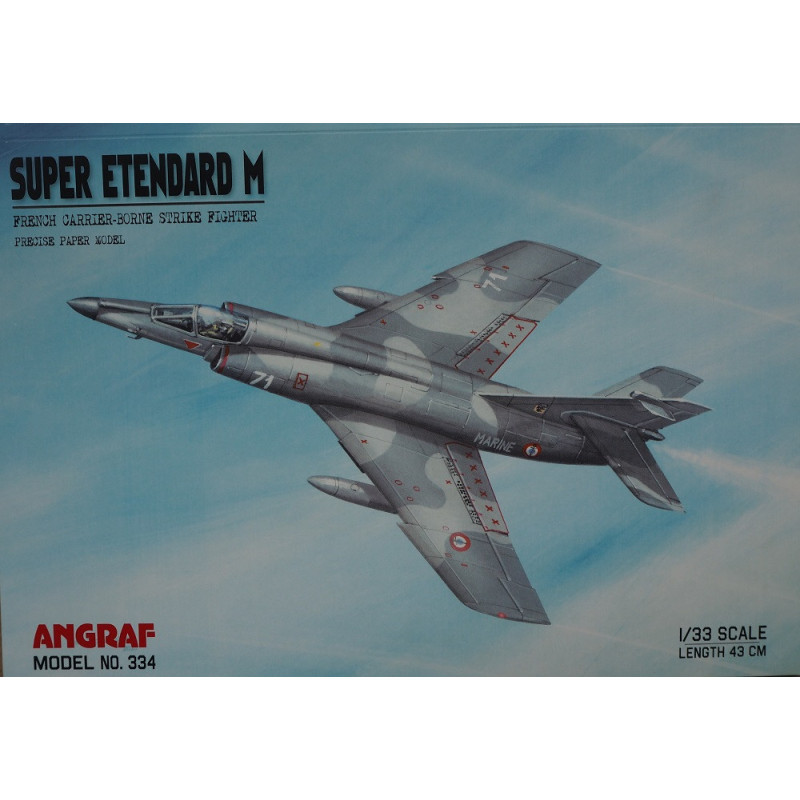


Publisher/ Manufacturer: "Answer" - "Angraf". Poland
Scale: 1 : 33
Number of sheets: 16 x B4
Number of sheets with details: 10
Number of assembly drawings: 32
Difficulty: For intermediate and advanced modelers.
Model dimensions: 433.5 mm x 291 mm x 116.5 mm
 Security policy
(edit with the Customer Reassurance module)
 Delivery policy
(edit with the Customer Reassurance module)
 Return policy
(edit with the Customer Reassurance module)
Development of the "Super Étendard" began in the late 1960s, when the French Navy's original "Étendard" aircraft were nearing the end of their service life. The fighters were to be replaced by a SEPECAT "Jaguar" variant, designated "Jaguar M". However, the project stalled due to political and technical problems, that arose during the trial deployment on aircraft carriers. This eventually led to the development of an improved version of the “Étendard”, called the “Super Étendard”. The new aircraft was slightly improved over its predecessor, but was significantly inferior to the “Jaguar” and had half the armament. This was probably not a concern for the French government, as it was focused on producing the aircraft, using almost 100 percent local components. The prototype first flew on 28 October 1974 and immediately afterwards the French Naval Air Force (Aéronavale) ordered 60 production aircraft, with deliveries beginning in June 1978. Although Dassault had hoped to secure foreign orders, the only export customer for the model was Argentina, which ordered 14 of the type for its sole aircraft carrier, the “ARA Veinticinco de Mayo”. However, by the time Argentina occupied the Falkland Islands, only five had been delivered, and only four had reached combat readiness. These aircraft entered service with the 2nd Wing of the 3rd Marine Squadron, based at Rio Grande do Sul in Tierra del Fuego, but their pilots had just completed training in France and were not prepared for war in the South Atlantic. In 1983, five “Super Étendards” were loaned to Iraq, which operated them until the delivery of previously ordered Dassault “Mirage’ F1EQ-5 fighters (armed with “Exocet” missiles). In the 1990s, the “Super Étendards” were modernized to carry the latest generation of precision, laser-guided weapons (AS30L laser missiles). Fighters, armed with these weapons, were designated “Super Étendard Modernisé”, or SEM for short. The modernization was carried out in several stages. Under Standard 4, in 2004, the aircraft were upgraded to carry optoelectronic surveillance and targeting modules with a “Damocles M” thermal imaging camera. Between 2008 and 2010, the remaining 35 aircraft were upgraded to Standard 5, with improved communications and the ability to carry guided bombs (GBU-58, 113 kg, and GBU-49, 227 kg). During the Falklands–Malvinas War, Argentina used five “Super Étendard” aircraft, armed with “Exocet” missiles to attack British ships. All five “Exocet” missiles, delivered with the aircraft, were used to sink the destroyer HMS “Sheffield’ (although, the warhead did not explode, “Sheffield” was destroyed by a fire, caused by the “Exocet” fuel) and the transport ship “Atlantic Conveyor”. The third British ship, to be hit by an “Exocet” missile, HMS “Glamorgan”, was attacked, using a ground-launched version of the missile. “Super Étendards”, armed with “Exocet” missiles, loaned to Iraq, were used in 34 attacks on Iranian tankers during the 1984–1985 Iran–Iraq War. At least one of these was shot down by an Iranian F-14 “Tomcat” or F-4 “Phantom II’ near Khargo Island, the rest being returned to France in 1985. French service “Super Étendard Modernisé” (SEM) aircraft were used in Operation “Allied Force” in Kosovo in 1999, flying over 400 missions. In 2001 the type was also used in Operation “Enduring Freedom” in Afghanistan. The last operational service mission of the French “Super Étendards’ ended in 2016. March; their final withdrawal from the French Navy took place in July of the same year.
A complex, well-designed and excellently detailed model, which will suit only medium-experienced and experienced modelers. The chassis, its niches, external detailing, cockpit interior are well detailed, there is a lot of armament, the suspension versions of which can be selected according to the assembly drawings, the air brakes can be made open or closed, or opening. There is not a very large color reserve. The textual instruction is small, and explains only the most complex parts of the model assembly, the graphical one is large-scale, detailed, informative and easy to read. The publication is from a test printing batch, so the details are printed on both sides of the detail sheets, but they are all completed there and the model can be assembled together perfectly.

You might also like
Publisher/ Manufacturer: "Answer" - "Angraf". Poland
Scale: 1 : 33
Number of sheets: 16 x B4
Number of sheets with details: 10
Number of assembly drawings: 32
Difficulty: For intermediate and advanced modelers.
Model dimensions: 433.5 mm x 291 mm x 116.5 mm