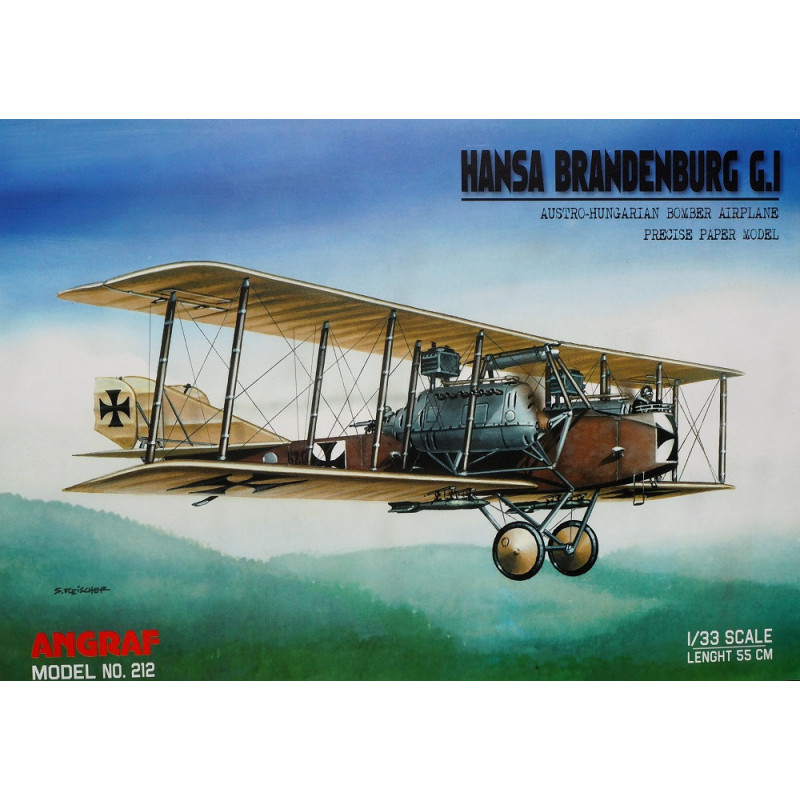


Publisher/ Manufacturer: "Answer" - "Angraf". Poland
Scale: 1 : 33
Number of sheets: 17 x B4
Number of sheets with details: 8 1/3
Number of assembly drawings: 89
Difficulty: For medium and experienced modelers.
Model dimensions: 297 mm x 545.5 mm x 127.5 mm
 Security policy
(edit with the Customer Reassurance module)
 Delivery policy
(edit with the Customer Reassurance module)
 Return policy
(edit with the Customer Reassurance module)
Hansa "Brandenburg" G. I - a bomber, used by the Austro-Hungarian Air Corps during World War I. The tri plate biplane had two folding wings of slightly different lengths. The pilot and bombardier sat in a large open cockpit, located in the front of the aircraft. Another open cockpit for the gunner was mounted behind the wings on top of the fuselage. One of the interesting features of the aircraft is, that it is equipped with engines, used in tractors of that time. The G. I engines are mounted on the sides of the fuselage, on steel support frames, although in large bombers of that time they were usually mounted directly on the wing or also with the help of supports. Such a system transferred most of the vibrations to the fuselage. The first production series of 16 aircraft was delivered in 1917. But soon they were all "grounded" and did not fly due to a contractual dispute between the manufacturer and "Flars". After the disputes ended, supplies were resumed, but the size of the order was reduced. The bombers were modified by "Flars" and they were sent to the Divach front airfield near the Italian border. "UFAG" produced 12 bombers, which differed slightly from their German counterparts. In G. I bombers were armed 3 combat and one reserve squadrons. But these bombers were quickly reclassified as training. During the three months, that the planes were used at the front, they completed only one successful mission.
A medium-size, medium-complexity, well-designed and richly detailed model, which is suitable only for medium-experienced and experienced modelers. But for advanced beginners and modelers with little experience, working under the supervision of a more experienced colleague, it is also "biting", You just need work without rushing, carefully and attentively. The model perfectly reproduces all visible external details, the chassis, cockpits equipment, engines, weapons (bomber tubes, machine guns, bombs), the control plates can only be made separate from the main plates. There are no reserves of colors and textures. The parts of the original aircraft, painted in the color of metal (or unpainted metal), are printed in the publication in "Metallic" silver color. The textual instruction in Polish is medium in size, covering the entire process of assembling the model, but very concise and only complements the large, informative, clear and easy-to-read graphical instruction.

You might also like
Publisher/ Manufacturer: "Answer" - "Angraf". Poland
Scale: 1 : 33
Number of sheets: 17 x B4
Number of sheets with details: 8 1/3
Number of assembly drawings: 89
Difficulty: For medium and experienced modelers.
Model dimensions: 297 mm x 545.5 mm x 127.5 mm