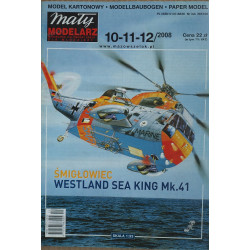


Publisher/ manufacturer: "Maly Modelarz". Poland
Scale: 1 : 33
Number of sheets: 10 x A4
Number of sheets with parts: 6
Number of assembly drawings: 10
Difficulty level: For any experience modelers.
Dimensions of the models: 212 mm x 318 mm x 68,5 mm ir 218 mm x 309 mm x 60,5 mm
 Security policy
(edit with the Customer Reassurance module)
 Delivery policy
(edit with the Customer Reassurance module)
 Return policy
(edit with the Customer Reassurance module)
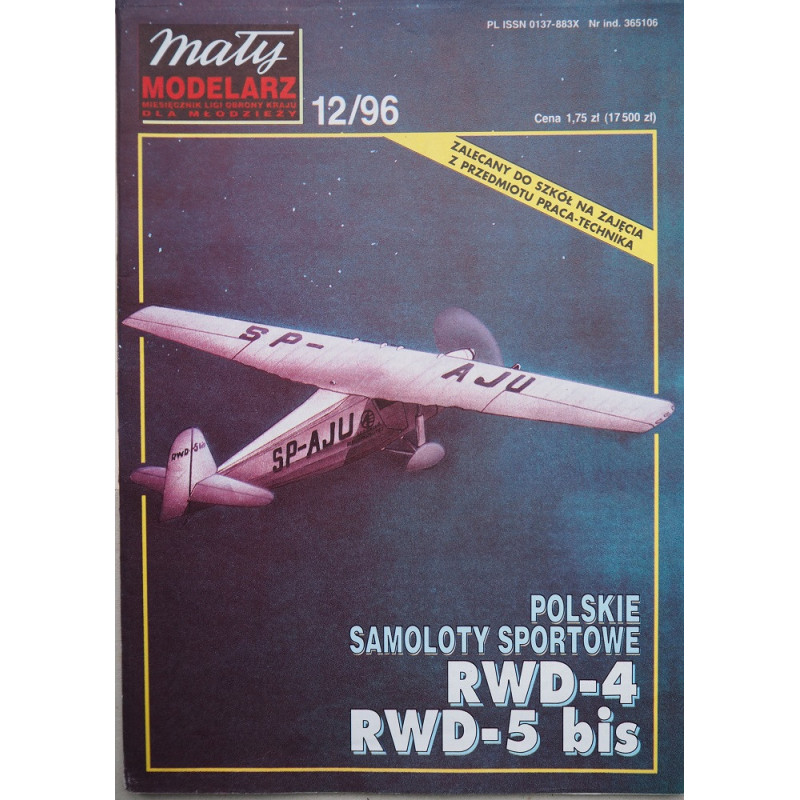
The two-seater sports aircraft was designed and manufactured by engineers Stanislaw Rogalski, Stanislaw Wigura and Jerzy Dziewecki in the Warsaw workshop RWD (from the first letters of the designers' surnames) in 1929. It was not a new design, but only the result of further development of the successful sports aircraft "RWD-2", with which Polish pilots achieved several international flight distance and altitude records for aircraft of this class in 1929. The "RWD-4" differed from its predecessor in its engine and larger dimensions. It was built specifically for the 1930 International European Tourist Airplane Race "'Challenge 1930". The first three examples with registrations SP-ADK (pilot – Franciszekas Zwirka), SP-ADL (pilot – Jerzy Bajan) and SP-ADM (pilot – Tadeusz Karpinski) and competition numbers 09, P1 and P2 participated in the raid across Europe, but they were not very lucky: only Jerzy Bajan completed the entire raid, taking 32nd place. SP-ADL was damaged during landing at Hendon Airport in England, repaired, but suffered an engine failure and withdrew from the race. Only 6 examples of the RWD-4 were built, which participated in the then fashionable raids and races. The last of them was written off in 1936.
The RWD-5 was produced in 1930 and was a further development of the RWD-4. Its design was significantly modified. For the first time in the history of RWD, the fuselage frame was assembled from steel tubes, the wing structure remained wooden. It was one of the most innovative sports-tourist aircraft in the world in the 1930s. Its cockpit was closed and had a good field of view, the aircraft was fast and could fly far without refueling. Its flight characteristics were also excellent. While flying the prototype, pilots Henrik Zwirko and Marian Pronaszka achieved several excellent records in the category of aircraft of this class. All this together led to the fact, that the RWD-5 was recognized as the best Polish sports aircraft of the interwar period. In 1932, the RWD-5 was chosen for a flight across the Atlantic. For this purpose, the SP-AJU exemplar was converted - an aluminum 300 l fuel tank was installed in the passenger seat, and another 4 x 113 l fuel tanks were installed in the wing consoles. This increased the aircraft's flight range to 5,000 km. Several changes were also made to improve the pilot's working conditions, and more instruments were installed on the instrument panel and the cockpit equipment was improved. The landing gear was strengthened and windows and doors in the rear cabin were removed. The single-seater aircraft thus converted, was designated "RWD-5bis". Captain Stanislaw Skarzinski made a test flight around Poland on April 15, 1933. He flew 1,650 km. On April 27, he left Warsaw for Rio de Janeiro. He flew in stages to Saint Louis in Senegal, from where he took off on a flight across the South Atlantic on May 7. After a difficult night flight, on May 8, it landed at Maceio Airport in Brazil. It flew 3,582 km and took 20 hours and 30 minutes. This set a record for the flight range of aircraft, weighing less than 450 kg. Later, the RWD-5bis was used by the Warsaw Aeroclub, and in September 1939 it was evacuated to eastern Poland, where it was taken over by the USSR army. In May 1940, it was exhibited in Kiev together with aircraft's, taken over from the Finnish aviation in Winter War. The further fate of the aircraft is unknown.
Two simple, excellently detailed models for modelers of any experience. Modelers with little experience can make these models without interior equipment and with opaque cockpit windows (at least the RWD-5bis, because the RWD-4 cabin is open on the sides and the interior equipment will have to be made), but they are recommended to work under the supervision of a more experienced colleague. There is no color reserves, the text instructions are quite extensive, clear and detailed, the graphics could be better. Antiquarian publication.

Publisher/ manufacturer: "Maly Modelarz". Poland
Scale: 1 : 33
Number of sheets: 10 x A4
Number of sheets with parts: 6
Number of assembly drawings: 10
Difficulty level: For any experience modelers.
Dimensions of the models: 212 mm x 318 mm x 68,5 mm ir 218 mm x 309 mm x 60,5 mm