

Publisher/ Manufacturer: "PRO-Arte" – "Modelarstwo Kartonowe". Poland
Scale: 1 : 33
Number of sheets: 8 1/2 x A4,
Number of sheets with details: 6 x A4
,Number of assembly drawings: 19
Difficulty: For modelers of any experience.
Model dimensions: 445 mm x 351mm x 114.5 mm
 Security policy
(edit with the Customer Reassurance module)
 Delivery policy
(edit with the Customer Reassurance module)
 Return policy
(edit with the Customer Reassurance module)
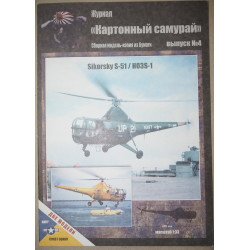
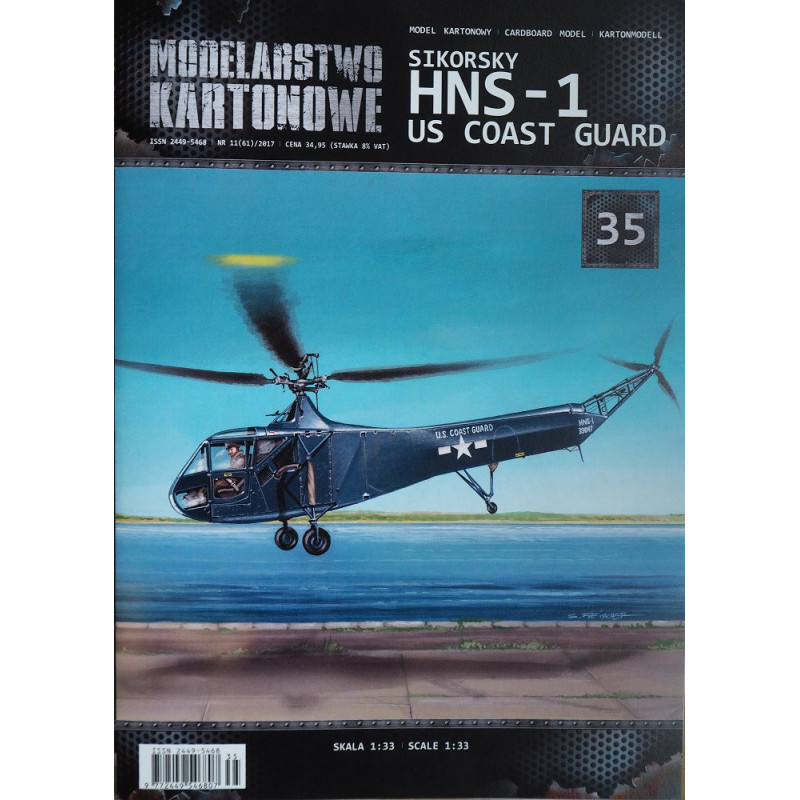
On September 14, 1939 the prototype of the Vought-Sikorsky VS-300 helicopter, designed by Igor Sikorsky, made its first flight (tethered). Nineteen different configurations were tested during the tests. The best configuration was one main rotor and one tail rotor, located at the end of the tail boom and rotating in a vertical plane, parallel to the direction of flight. The success of the VS-300 led the United States Army Air Corps (USAAC) to place an order for a new helicopter with improved performance in January 1941. The new Vought-Sikorsky VS-316A (Sikorsky S-47 series) and its military version, the XR-4, were developed on the basis of the VS-300. The XR-4 prototype first flew on January 14, 1942. Initially, the fuselage was unskinned, and two tail rotors were installed for control. After the first tests, the helicopter was modified. The fuselage was covered with covers, and the two tail rotors were replaced with a single one. In May 1942 the XR-4 flew for testing at the USAF Proving Ground at Wright Field, Ohio. In 1943 the XR-4 was redesigned to use the R-550-1 engine and a larger rotor. This prototype was designated the XR-4C and a series of tests were conducted. In late 1942 the Air Force ordered 30 pre-production helicopters. All were powered by the Warner R-550-1 engine. The first three helicopters were 10.82 m (32 ft) long (like the XR-4), and were designated the YR-4A. The remaining 27 helicopters with a longer fuselage were designated the YR-4B. Production of 100 R-4B serial helicopters began in 1944. They were identical in design to the YR-4B, but were powered by the R-550-3 engine. In July 1942 the US Navy became interested in the R-4 helicopter and received three YR-4Bs and 20 production R-4Bs from the US Air Force. All of them were designated HNS-1. The US Navy transferred 21 helicopters to the US Coast Guard, where they were used for training and rescue operations. The R-4 is the first American production helicopter, as well as the world's first production single-rotor helicopter. Due to its poor performance, its operational use in the armed forces was limited. It was used for testing, training, communications and dispatch flights and rescue missions. The YR-4B made the first successful helicopter landing on a ship.
A not very complex, well-designed and richly detailed model of a World War II helicopter for modelers of any experience. Only for beginners or less experienced modelers, we recommend working under the supervision of a more experienced colleague, not to rush and do the interior equipment of the cabin, transparent windows as a test: if it works out - GREAT!!! - we make a full model, if not - we will have to be content with a model with opaque cabin windows. The model perfectly recreates the cabin equipment, chassis, excellent exterior detailing, only the appearance of the model is quite monotonous due to the painting in one color. The model can be made with an open engine compartment with all its equipment, and there are also parts for the crew's personal weapons - the Thompson M1A1 and Sten Mk.II submachine guns. There is a color reserve. There are no textual instructions at all, the graphical ones are large, detailed, informative and easy to read. From the publication You can make a model of the Sikorsky HMS-1 helicopter of the US Coast Guard Service of the second half of the 1940s.

Publisher/ Manufacturer: "PRO-Arte" – "Modelarstwo Kartonowe". Poland
Scale: 1 : 33
Number of sheets: 8 1/2 x A4,
Number of sheets with details: 6 x A4
,Number of assembly drawings: 19
Difficulty: For modelers of any experience.
Model dimensions: 445 mm x 351mm x 114.5 mm