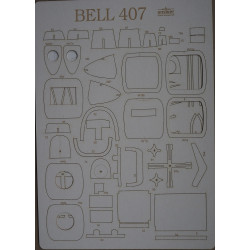
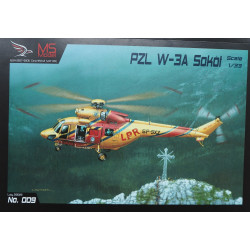
Publisher/ Manufacturer: "Answer" – "Kartonowy Swiat". Poland
Scale: 1 : 33
Number of sheets: 10 x B4
Number of sheets with details: 6 1/2
Number of assembly drawings: 14
Difficulty: For modelers of any experience.
Model dimensions: 386 mm x 324 mm x 100.5 mm
 Security policy
(edit with the Customer Reassurance module)
 Delivery policy
(edit with the Customer Reassurance module)
 Return policy
(edit with the Customer Reassurance module)
The Bell 206L-4 “Long Ranger” helicopter, developed by the American company “Bell Helicopter Textron”, was used as the base model. The prototype first took to the air on April 21, 1994. The first flight of the pre-series helicopter took place on June 29, 1995. (C-GFOS). In 1996 the helicopter was certified by the FAA and TCCA. The first helicopters were ordered by “Petroleum Helicopters’. By 1999 more than 300 units had been manufactured. On June 15, 2010 the 1,000th helicopter was delivered. In 2015 the Ural Civil Aviation Plant (Yekaterinburg, Russia) became the official representative of “Textron Aviation” in the Russian Federation and manufactured the first light passenger helicopter in Russia, the Bell-407, from components, supplied by the American manufacturer “Bell Helicopter Textron”. The Bell 407 is equipped with a four-blade main rotor, developed for the OH-58D (model 406). The blades and the fuselage are made from composite material without a limited service life and, compared to previous models, provide improved performance and flight comfort. The main rotor pylon design uses vibration-isolating measures, the same measures are implemented in the landing gear design to eliminate ground resonance. Compared to the Bell 206, the 407 fuselage is 18 centimeters wider, which increases the cabin volume. The glazing area has been increased by 35%. The helicopter is equipped with a Rolls-Royce/Allison 250-C47 turbine engine, the take-off power of which is 813 h. p. (606 kW), the maximum continuous power of which is 700 h. p. (522 kW). The engine is equipped with a single-channel FADEC type electronic control system. The standard fuel tank capacity is 477 liters. At the customer's request, an additional 75-liter fuel tank can be installed in the rear luggage compartment. The engine provides a higher maximum take-off weight and improves performance at high temperatures and altitudes. The 407's fuselage is largely similar in appearance to the “Long Ranger”, but differs from it in its tail beam, which is made of carbon fiber. In its standard configuration, the helicopter has places for two crew members and five passengers. In 1995 “Bell” tested a circular tail rotor, but this idea was later abandoned. “Bell’ engineers also studied the possibility of installing two engines in the Bell 407, but instead decided to create an entirely new twin-engine helicopter, which was named the Bell 427. It is equipped with two PW206D engines from “Pratt & Whitney Canada”. The Bell 407 helicopter gained great fame for its record-breaking flight around the world, the route of which passed through both poles of the Earth. The helicopter with two crew members took off from Fort Worth Airport in Texas on December 5, 2006 and returned on May 23, 2007. In 189 days he covered more, than 57,900 km and made dozens of landings, including at the South and North Poles. The NETO flight time was 300 hours. Helicopters of this type are often used by the Police of various countries (including Poland).
A medium-size model of a medium-size helicopter, quite simply designed and moderately detailed, is intended for modelers of any experience. Only advanced beginners and modelers with little experience are recommended to work under the supervision of a more experienced colleague, don’t rush, work carefully and accurately, something (interior) can be done as a test: if it works - we have a beautiful and competitive model, if it doesn’t work - we make the windows opaque. The model perfectly, but easily, reproduces all the external detailing, rotors, landing gear, cockpit and passenger compartment detailing, the model is painted in the Polish Police camouflage. There are no color reserves, the textual instructions in Polish are large, detailed, perfectly explaining the entire process of assembling the model and complementing the small, but quite informative and easy-to-read graphical instructions well.

You might also like
Publisher/ Manufacturer: "Answer" – "Kartonowy Swiat". Poland
Scale: 1 : 33
Number of sheets: 10 x B4
Number of sheets with details: 6 1/2
Number of assembly drawings: 14
Difficulty: For modelers of any experience.
Model dimensions: 386 mm x 324 mm x 100.5 mm