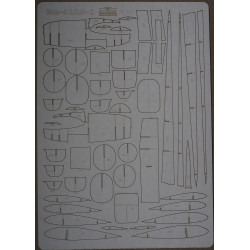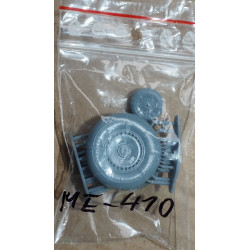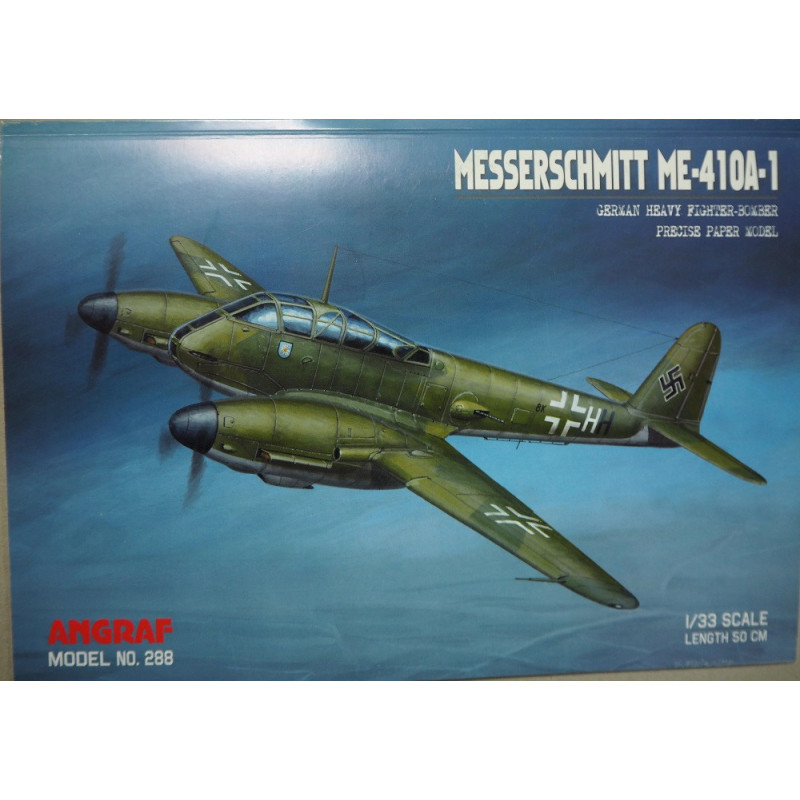


Publisher/ manufacturer: “Angraf". Poland
Scale: 1 : 33
Number of sheets: 13 x B4
Number of sheets with parts: 7
Number of assembly drawings: 11
Difficulty level: For medium experience and experienced modellers
Dimensions of the model: 378 mm x 495,5 mm x 129,5 mm
 Security policy
(edit with the Customer Reassurance module)
 Delivery policy
(edit with the Customer Reassurance module)
 Return policy
(edit with the Customer Reassurance module)
Messerschmitt Me-410 "Hornisse" (German: Hornet) - German World War II twin-engine all-metal low-wing heavy fighter-bomber with classic tail plates. It was based on a modified Messerschmitt Me-210 spread-body fuselage, fitted with new "Daimler-Benz" DB 603A engines in longer nacelles. Compared to the Me-210, the wing leading edge angle was reduced. The first Me-410 prototype was completed in 1942. To test the new aircraft, six Me-210A aircraft were converted to Me-410 standard, leaving the old "Daimler-Benz" DB 601 F engines. These were the Me-210A-1 and Me-210A-2. The aircraft was then transferred to the Japanese and tested there to see, if it was suitable for Imperial aviation. The Me-410 development program included more prototypes, converted from Me-210 airframes (e.g. the Me-410 V22, which was the Me-210A-0 modification, was also built from scratch as the Me-410 (e.g. Me-410 V18). Prototype tests showed, that the Me-410's flight characteristics significantly exceeded those of the Me-210. The characteristics of the new fighter were significantly better, than those of the Messerschmitt Bf-110 and this predicted its success. Due to this fact, the RLM decided to put the Me-410 into serial production. The aircraft was to be produced in two main variants: the Me-410A-1 "Schnellbomber' (fast bomber) and the A-2 'Zerstörer' (fighter). Production of the Me-410A-1 began in January 1943, and the first fighters reached Luftwaffe units at the end of the same month. The artillery armament of this version did not differ from that, of the Me-210 (two 20 mm MG 151 cannons and two 7.92 mm MG 17 machine guns, placed in the forward fuselage, and two 13 mm movable MG 131 machine guns). The bomb armament was placed in a compartment, located in the forward fuselage. The aircraft could carry one SC 1000 or SD 1000 bomb weighing 1000 kg, or two SC 500 bombs weighing 500 kg each, or up to eight SC 50 bombs weighing 50 kg each. The bomb sight used the "Stuvi 5B", adapted for dropping bombs from a dive. There were several modifications of the Me-410A-1. In the Me-410B version, the ground attack version, the aircraft was equipped with additional suspension units for four 210 mm unguided rockets under the wing.
A medium-sized, well-designed and quite richly detailed model for medium-experienced and experienced modelers. However, without making the cockpit equipment, making the cockpit canopy opaque, retracted landing gear and taking Your time and working under the supervision of a more experienced colleague, this model will be perfectly assembled by both an advanced beginner and a modeler with little experience. The cockpit and landing gear are perfectly detailed, there is not much external detailing (there are not even bombs and missiles), so the model is definitely not one of the top ten complex ones. The graphic instructions are small, quite informative, but could be better, the textual ones - only a few sentences. There is a color range, but it is very small.

You might also like
Publisher/ manufacturer: “Angraf". Poland
Scale: 1 : 33
Number of sheets: 13 x B4
Number of sheets with parts: 7
Number of assembly drawings: 11
Difficulty level: For medium experience and experienced modellers
Dimensions of the model: 378 mm x 495,5 mm x 129,5 mm