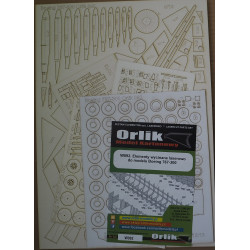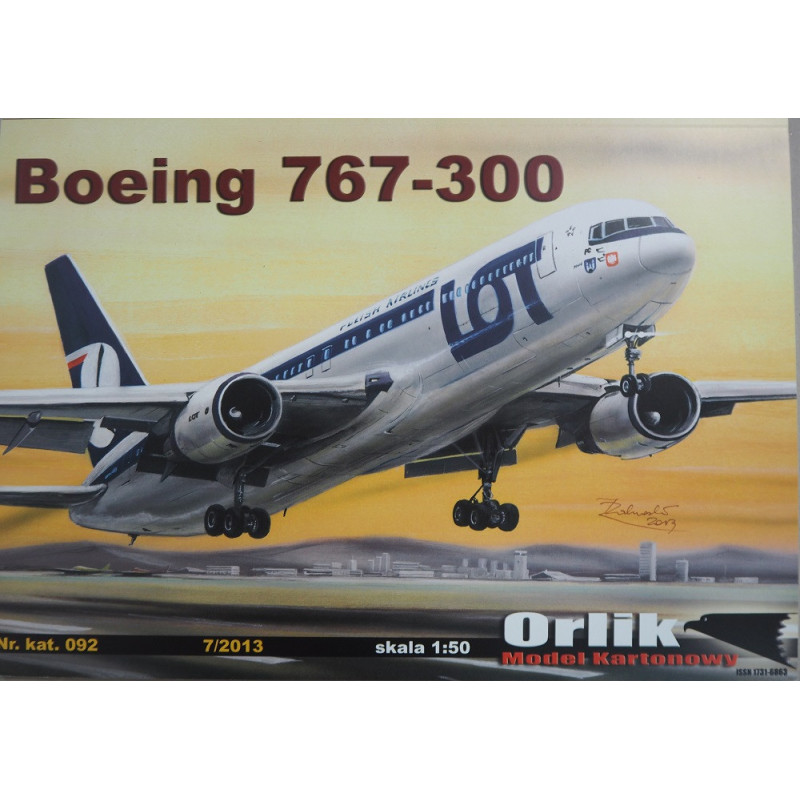


Publisher/ Manufacturer: “Orlik”. Poland
Scale: 1 : 50
Number of sheets: 35 x A3
Number of detail sheets: 29
Number of assembly drawings: 102
Difficulty: For medium experience and experienced modelers.
Model dimensions: 1098 mm x 950 mm x 337 mm
 Security policy
(edit with the Customer Reassurance module)
 Delivery policy
(edit with the Customer Reassurance module)
 Return policy
(edit with the Customer Reassurance module)
The Boeing 767 is a long-distance, low-wing, twin-engine, monoplane passenger aircraft, manufactured in the United States. The aircraft is powered by two “Pratt and Whitney’ JT-9D or PW4000 or “General Electric” CF6 or “Rolls-Royce” RB211 engines. The first prototype flight took place in 1981; serial production began in 1982 and is still ongoing. By April 2014, 1,030 copies of this aircraft had been produced. The Boeing 767 was developed by the Seattle-based company in an attempt to respond to the fuel crisis of the 1970s, which forced the development of aircraft, which could carry passengers and cargo over long distances, but consume much less fuel, than previous aircraft. In addition, during this period, the “Boeing” concern grew into a major competitor to the European consortium “Airbus”, which had been in the business since 1972 and offered the successful A300 model. The Boeing 767 turned out to be an innovative machine - it was equipped with a lot of modern electronic equipment, which allowed the crew to reduce to 2 people. However, the use of the "fly-by-wire" system was not installed, despite the fact, that “Airbus” aircraft used it. During serial production, several main versions of this very successful aircraft were created, which differ mainly in the passenger cabin capacity and the engines used and the flight range. The 747-400 ER version, tested in 2000, can carry up to 375 passengers, and the flight range is 10,415 km.
Although large, but a model of medium complexity. The full version (with a pilot’s cabin, full detail of the passenger salon, visible engine parts, landing gear and its niches) is recommended only for modelers of medium experience and advanced level. Less experienced modelers, working under the supervision of a more experienced colleague, can assemble this model without interior detailing, with the landing gear intake, simplified visible engine parts and opaque glass. There is no stock of colors, the metal color parts on the original aircraft is printed with "Metalic" type silver paint in edition, which is not as expressive in an offset printed publication, as when printed on chalk paper. The model recreates the appearance of the Polish airline "LOT" aircraft SP-LPC. The textual instructions are small - only general provisions, the graphic ones are large and will serve You well in the model assembling process.

You might also like
Publisher/ Manufacturer: “Orlik”. Poland
Scale: 1 : 50
Number of sheets: 35 x A3
Number of detail sheets: 29
Number of assembly drawings: 102
Difficulty: For medium experience and experienced modelers.
Model dimensions: 1098 mm x 950 mm x 337 mm