

Publisher/ Manufacturer: "Answer" – "MP Model". Poland
Scale: 1 : 33
Number of sheets: 10 x B4
Number of sheets with details: 7
Number of assembly drawings: 15
Difficulty: For modelers of any experience.
Model dimensions: 310.5 mm x 396 mm x 121 mm
 Security policy
(edit with the Customer Reassurance module)
 Delivery policy
(edit with the Customer Reassurance module)
 Return policy
(edit with the Customer Reassurance module)
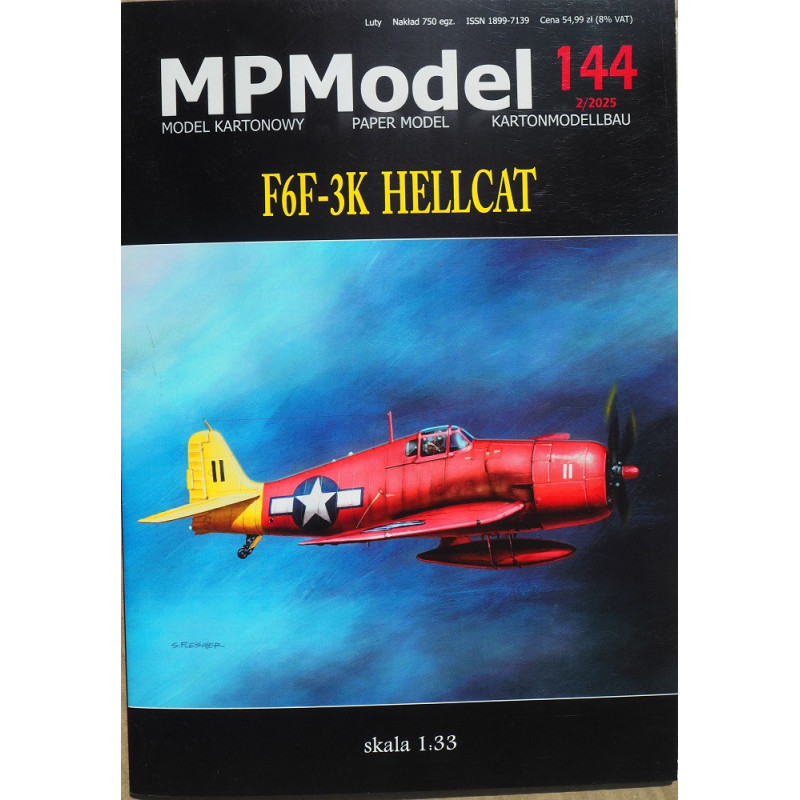
Grumman F6F “Hellcat’ – the US deck fighter of World War II, low-wing single-seat single-engine monoplane. One of the most famous aircraft, that participated in the battles in the Far East. Produced in 1942 – 1945 (about 14,000 units produced), the most popular versions F6F-3 and F6F-5. They hold the record for the most enemy aircraft, shot down by a single type of fighter – 5216, of which 5156 were Japanese aircraft. The prototype of the fighter was built by a Grumman design group led by Leroy R. Grumman from 1938 to 1941. It was conceived as a further version of the F4F “Wildcat” fighter and was supposed to be a response to the comments of pilots, who flew those fighters. But there were so many changes, that it was no longer a modification, but the construction of a new aircraft. The range, speed, reinforced armament and armor were increased, a new more powerful engine, a larger diameter propeller, a new landing gear design, and increased fuel and ammunition reserves were installed. The increase in mass, caused by these changes, forced the constructors to increase the wing area. The contract for the production of the prototype was signed on June 30, 1941, and the prototype first took to the air on June 26, 1942. It was powered by a Wright R-2600-16 “Cyclone” engine, and its first flight lasted 25 minutes and was successful. On July 30, a second prototype with an 18-cylinder Pratt and Whitney R-2800 “Double Wasp” engine, designated XF6F-3, first flew. The F6F-3 was the first production version with a 1,491 kW (2,000 h. p.) “Pratt and Whitney” R-2800 engine, later versions were equipped with a “Pratt and Whitney “R-2800-10W with additional water injection, developing 1,641 kW, and was armed with six 12.7 mm (0.5 in) machine guns, mounted in the wing. A total of 4,402 of these were built. The first unit to be armed with these fighters, was the US Navy VF-9 squadron from the aircraft carrier USS “Essex”, and this happened in January-March 1943. It was first used in combat conditions on August 31, 1943. During the attack on Howard and Baker Islands on September 1, 1943, the pilots of the VF-6 squadron achieved their first aerial victory. On October 5 and 6, 1943, during the attack on Wake Island, the first clash with Japanese “Zero” fighters took place, which showed, that the “Hellcat” was superior to its opponent in many characteristics. By the end of 1943, the “Hellcat” was already on all aircraft carriers, operating in the Pacific. About 1300 exemplars of different versions of the “Hellcat” were purchased by Great Britain, one of which (not yet repainted in British colors) is depicted in the model from the publication.
A small model of a small aircraft, a well-designed and richly detailed, medium-complexity model of a US-made fighter. The model is suitable for modelers of any experience. Only beginners and modelers with little experience should work under the supervision of a more experienced colleague, don’t rush and do the cockpit equipment, transparent windows and the released landing gear as an experiment: if You succeed - HURRACH!!! - we will make a full-fledged model, if You fail - You will have to make a model without cockpit detailing, with the landing gear included... The model perfectly reproduces all visible exterior details, landing gear, its niches, cockpit equipment, and beautiful "non-military" camouflage. There is a small supply of colors, the textual instructions in Polish are small and only describe the process of gluing the model in general terms, but they perfectly complement the not very large, but quite informative and easy-to-read graphic instructions.

You might also like
Publisher/ Manufacturer: "Answer" – "MP Model". Poland
Scale: 1 : 33
Number of sheets: 10 x B4
Number of sheets with details: 7
Number of assembly drawings: 15
Difficulty: For modelers of any experience.
Model dimensions: 310.5 mm x 396 mm x 121 mm