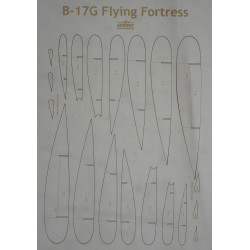
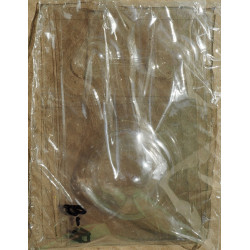
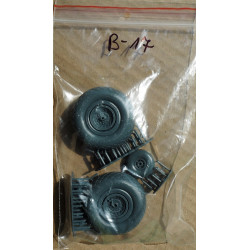
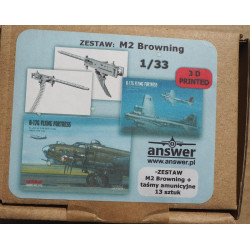
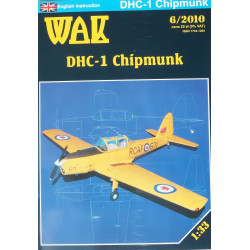
Publisher/ Manufacturer: "Answer" - "Angraf". Poland
Scale: 1 : 33
Number of sheets: 36 x A3
Number of sheets with details: 30
Number of assembly drawings: 73
Difficulty: For intermediate and experienced modelers.
Model dimensions: 690.5 mm x 958 mm x 175.5 mm
 Security policy
(edit with the Customer Reassurance module)
 Delivery policy
(edit with the Customer Reassurance module)
 Return policy
(edit with the Customer Reassurance module)
The Boeing B-17 "Flying Fortress" - the US-made long-range heavy bomber of World War II. It is, perhaps, the most famous bomber in the history of aviation. Initial design work at BAC (“Boeing Airplane Company”) began on June 18, 1934. This new aircraft was to be powered by 4 nine-cylinder air-cooled Pratt and Whitney R-1690-E "Hornet" engines, each of which developed 750 h. p. power. The first flight of the prototype took place on July 28, 1935 at Seattle Airport. After testing at the “Boeing” factory, the aircraft, designated B-299, was transferred to the USAF. Tests conducted by the US Air Force showed a crushing advantage of the “Boeing” prototype over its competitors (Martin - 149 and Douglas DB-1). 13 ordered aircraft with the designation YB-17 were transferred to the army in 1937. This was the first serial version of the "Flying Fortress". The next serially produced version was designated B-17B, and first took off in Seattle on June 27, 1939, and soon “BAC” produced 39 previously ordered aircraft. The next version was the B-17C, then the B-17D, which was already fighting in the air over Great Britain. The constant modification of the bomber and the introduction of new technical solutions led to the emergence of new versions. The first large-scale version was the B-17F, of which 3405 aircraft were produced. In July 1943 a new serial version, the B-17G, began production. It differed from the previous version only in its more powerful armament - 12 heavy air-cooled “Browning” M2 machine guns (0.5 caliber -12.7 mm): two in the lower front “Bendix” turret with a reserve of 300 rounds each, one machine gun on the each sides of the front part (500 rounds each), two in the upper turret (500 rounds each), two in the lower fuselage turret “Sperry” (500 rounds each), two on the each sides of the rear fuselage (400 rounds each) and two in the rear device or “Cheyenne” type turret (500 rounds each). The B-17G crew consisted of 10 people: pilot, co-pilot, bomber, navigator, radio operator and 5 gunners, the plane could carry 2200 kg of bombs.
A large and well-designed and richly detailed model of a large plane, which is suitable only for medium-experienced and experienced modelers. The model perfectly reproduces all visible exterior details, landing gear, its niches, cockpit equipment, engines, armament (bomb hatches, machine guns, bombs), control plates can be made either together with the main plates or separately from them. There are no stock colors and textures. The parts of the original plane, painted in the metal color (or unpainted metal) are printed in the publication in the "Metalic" silver color. You can choose cladding details, printed in one of two printing methods: offset (less expressive "metal", but easier to glue) or chalk printing ("metal" looks almost like real polished aluminum, but is more difficult to glue, because not all glues glue paper, printed in this way. In addition, You need to be very careful not to get glue, where it is not needed - this printing method does not forgive this). The textual instruction in Polish is quite large, covering the entire process of gluing the model, but very concise and only complement the large, informative, clear and easy-to-read graphical instruction. Only some of these drawings could be larger.

You might also like
Publisher/ Manufacturer: "Answer" - "Angraf". Poland
Scale: 1 : 33
Number of sheets: 36 x A3
Number of sheets with details: 30
Number of assembly drawings: 73
Difficulty: For intermediate and experienced modelers.
Model dimensions: 690.5 mm x 958 mm x 175.5 mm