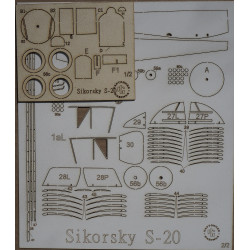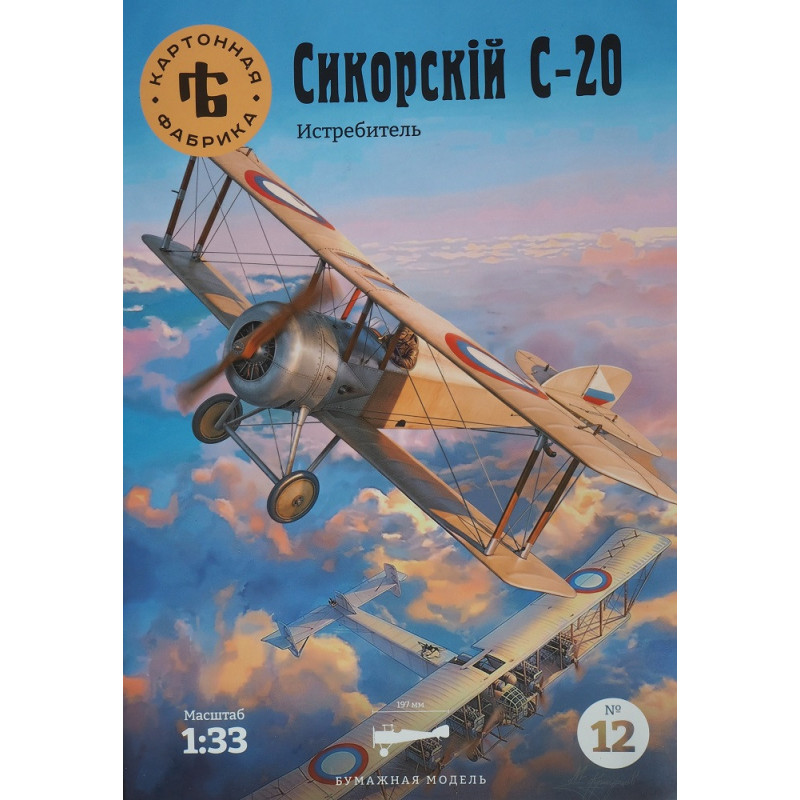


Publisher/ Manufacturer: "Картонная фабрика". Russia
Scale: 1 : 33
Number of sheets: 8 x A4
Number of sheets with details: 4 1/2
Number of assembly drawings: 29
Difficulty: For modelers of any experience.
Model dimensions: 197 mm x 260.5 mm x 79 mm
 Security policy
(edit with the Customer Reassurance module)
 Delivery policy
(edit with the Customer Reassurance module)
 Return policy
(edit with the Customer Reassurance module)
The last light aircraft, that I. Sikorsky designed in Russia, was a single-seat fighter – biplane S-20. It embodied all the experience, gained from the operation of its predecessor S-16, as well as the experience of observing the best foreign fighters. The aircraft was built very quickly, according to sketch drawings and Sikorsky's own instructions, without the preparation of factory drawings. But the aircraft was a success. The first prototype was built in September 1916 and looked quite dashing from the outside. The ailerons was mounted on the upper wing, which were larger, than the lower wing. The “Gnome Monoscoupe” engine was mounted in the forward of fuselage and was completely covered by tin hoods. The tests, that began, showed that the engine posed a number of problems, did not have sufficient power, and Sikorsky did not have other suitable engines at that time. The experimental S-20 prototype was sent to the combat squadron without an engine in early 1917, but two sets of wing plates of different spans were added. They were to be selected during the tests. Shidlovsky, who led the tests, requested rotative engines “Gnome-Rhone” (110 h. p.) and “Clerget” (130 h. p.) from the Main Military Equipment Directorate. It was even planned to convert the fighter to a linear water-cooled 150 h. p. power engine "Hispano Suiza". But only the "Rhone" engine was received. The tests of the fighter with this engine showed excellent flight and combat characteristics and according to them the plane surpassed many of the best designs of 1916-1917. It was faster, than the "Nieuport", but slower than the "Vickers" fighters. The "Avia-Balt" factory expressed the initiative to produce a large series of these aircraft - at least 50 units, but it was 1917 and therefore only 5 S-20s were produced. But there is information about the use of only one of these aircraft: the aircraft with the serial number 267 was tested in the Air Ship Squadron in early 1917 by pilots Romanov and Nizhevsky. The events of 1917 disrupted all plans for the development of Russian aviation, so Sikorsky and his assistants were unable to fulfill all their plans.
A small, well-detailed and well-designed model of a small and simple fighter for any modeler. Everything, that can be seen in a model of this scale from the outside, is detailed, but the plane (and at the same time - the model) was not very complicated. Therefore, it will be perfect even for beginners, who have glued together several simple models, and for modelers with little experience, working under the supervision of a more experienced colleague. The most problems will be the correct assembly of the wing plates and their mounting, as well as the providing of rods and struts. There is a considerable reserve of colors, where necessary, the parts are printed double-side printing. Only conventional markings in Russian remain from the textual instructions, but the graphical ones are simply wonderful. The model recreates the appearance of the S-20, marked with the factory number 267 and which was from the end of 1916 at the Petrograd Commandant's airfield, where it conducted tests in September-October 1916.

You might also like
Publisher/ Manufacturer: "Картонная фабрика". Russia
Scale: 1 : 33
Number of sheets: 8 x A4
Number of sheets with details: 4 1/2
Number of assembly drawings: 29
Difficulty: For modelers of any experience.
Model dimensions: 197 mm x 260.5 mm x 79 mm