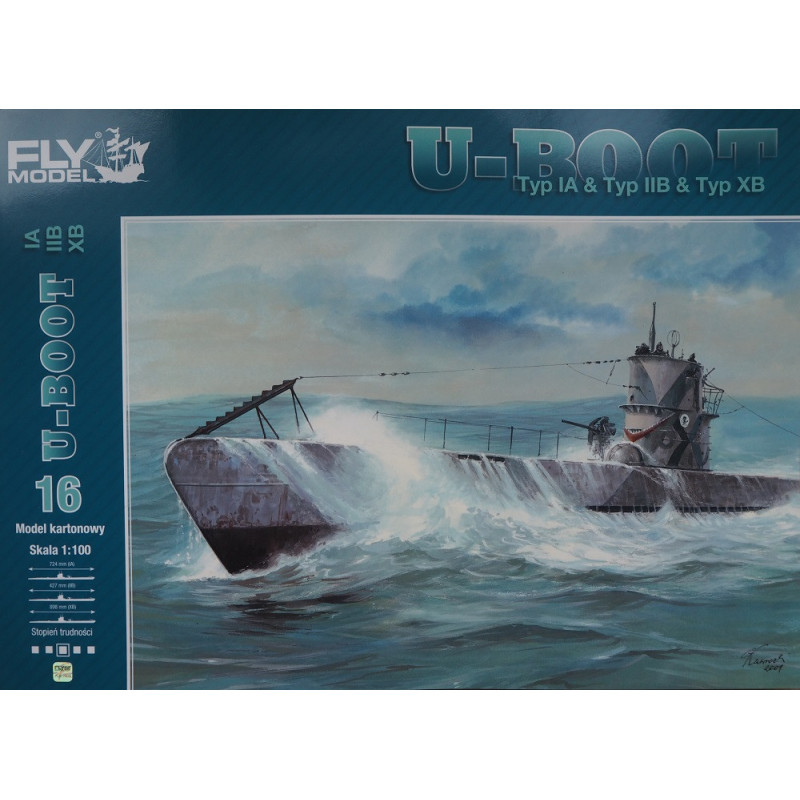


Publisher/ Manufacturer: "Gomix - Fly Model". Poland
Scale: 1 : 100
Number of sheets: 27 x A3
Number of sheets with details: 12 1/2
Number of assembly drawings: 61
Difficulty: For intermediate and experienced modelers.
Laser-cut detail sheets: 6 x 1 mm x A3
Number of laser-cut details: 243
Model’s dimensions: 724 mm x 62 mm x 111.5 mm; 427 mm x 41 mm x 78 mm; 898 mm x 92 mm x 128 mm
 Security policy
(edit with the Customer Reassurance module)
 Delivery policy
(edit with the Customer Reassurance module)
 Return policy
(edit with the Customer Reassurance module)
Type IA – the German submarines (U-boats), built in 1936 to create an ocean-going submarine for the Kriegsmarine. Their construction was based on a project, developed by the German company “IvS”, founded in the Netherlands to circumvent the prohibitions of the Treaty of Versailles. The company prepared a project for these submarines for Spain as Typ E-1. Most of the prototype ship's structure was manufactured in the Netherlands and then transported to Spain for final assembly. However, the authorities of the then new Spanish Republic refused to accept the submarine into service and, shortly before its completion at the “Echovarrieta y Larringa” shipyard, it was sold to Turkey in 1934, where it served as the “Gür”. The same construction was used to build ocean-going submarines for the Kriegsmarine, when the Third Reich decided to resume submarine building. Only two ships of this type were built for Germany by the Bremen AG “Weser” shipyard, the U-25 and the U-26, but they had a number of shortcomings. These submarines had stability problems, were characterized by a long submerged time, were difficult to control, when submerged, and had a number of other mechanical problems. Despite this, both ships sailed successfully in the early months of World War II. U-25 sank eight ships and damaged one, U-26 sank eleven and damaged two. On 1 July 1940 U-26 was sunk near Ireland, damaged by the British corvette HMS “Gladiolus” and the Australian flying boat Short “Sunderland”. On 1 August 1940 U-25 sank near Terschelling after striking a mine, she had laid herself. Meanwhile, the Turkish “Gür” was struck from the naval list in 1950.
The Type II (so-called "Einbaum" - carved canoe) submarines were the first type of German submarines, to be developed after the First World War. The first 12 ships of this class were built by 1935 in a secret section of the “Germania” shipyard and “Deutsche Werke” AG in Cologne. They were based on the “Vesikko”, a submarine, previously projected for Finland by the “Ingenieurkantoor voor Scheepsbouw den Haag (I.v.S.)” and built at the “Chrichton-Vulcan” shipyard in Turku (1933). The first German Type II submarine was commissioned on 29 June 1935. They served as a good school for the future development of the Third Reich's submarine fleet. They were mainly used for training and coastal defense. The submarines of this class had three bow torpedo tubes; initially they did not have a deck gun. After gaining experience in the war, it was decided to equip the ships with 20 mm anti-aircraft artillery. They were characterized by a slow submergence due to the low-power electric motors, used underwater instead of diesel engines. Due to the relatively large difference between the surface and underwater displacements, the ships submerged very slowly. A serious drawback of the ships was their short range (3,100 nautical miles) and cramped interior. As a result, their operations were limited to the North Sea and the east and west coasts of England. During the war, they were also used in combat operations during the invasion of Norway in 1940, and were transported by land to Linz, then floated down the Danube to the Black Sea, where they fought against the Soviet Union.
Type X - a series of large German submarines, designed in 1938 as long-range minelayers. A total of eight modified XB project submarines were built between 1939 and 1944. The XB type ships with a total displacement of 2,710 tons were the largest German submarines. Due to their large size, they were slow to submerge and difficult to control. The main armament of the submarine consisted of 66 “SMA” type mines, placed in 30 mine shafts, located along the sides of the ship. When used as a transport, cargo containers were placed in the shafts or attached above them, but then the submarine could not carry mines. Submarines of this type did not have forward torpedo tubes, and two stern tubes had a reserve of 15 torpedoes. The ship's armament consisted of a 105 mm gun with 200 rounds. Anti-aircraft defense was provided by two anti-aircraft guns: one 37 mm and one 20 mm. Between 1939 and 1944 eight submarine minelayers were built at the “Germaniawerft” shipyard in Kiel, based on a modified XB project. Six of them were sunk, and four of them with their entire crew. Two survived the war: U-219 was interned by Japanese forces, and U-234 surrendered to the American destroyer USS “Sutton”.
Well-designed, well-detailed models of not very large (Typ II - very small) submarines for medium-experienced and experienced modelers. However, working under the supervision of a more experienced colleague, these models can be perfectly assembled by both an advanced beginner and a modeler with little experience. There is no room for haste here, and You will need to work carefully and attentively. The models detail everything, that can be reproduced in models of this scale (exterior): hull, control and propulsion complex, armament, control cabin, armament, all other equipment. All models come with sets of laser-cut parts, cut from 1 mm thick cardboard, and there is also another 1 mm thick cardboard sheet for spare parts. There are no reserves of colors. The textual instructions (in Polish, English, Russian) have a general part and a separate part for each model. They are not extensive, but they complement the good, well-illustrated, informative and easy-to-read graphical instruction (also separate for each ship) quite well.

You might also like
Publisher/ Manufacturer: "Gomix - Fly Model". Poland
Scale: 1 : 100
Number of sheets: 27 x A3
Number of sheets with details: 12 1/2
Number of assembly drawings: 61
Difficulty: For intermediate and experienced modelers.
Laser-cut detail sheets: 6 x 1 mm x A3
Number of laser-cut details: 243
Model’s dimensions: 724 mm x 62 mm x 111.5 mm; 427 mm x 41 mm x 78 mm; 898 mm x 92 mm x 128 mm