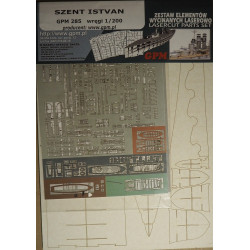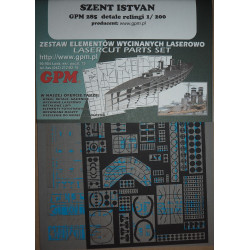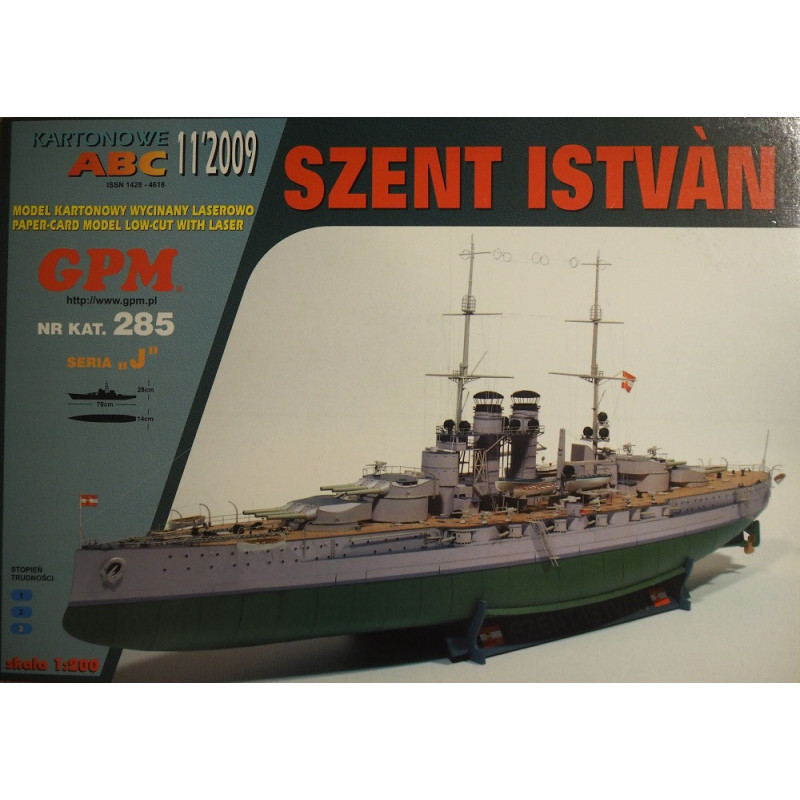


Publisher/ Manufacturer: "GPM". Poland
Scale: 1 : 200
Number of sheets: 31 x A3
Number of sheets with details: 19
Number of assembly drawings: 146
Difficulty: For medium and experienced modelers.
Model dimensions: 761 mm x 140 mm x 288.5 mm
 Security policy
(edit with the Customer Reassurance module)
 Delivery policy
(edit with the Customer Reassurance module)
 Return policy
(edit with the Customer Reassurance module)
The "Tegetthoff" class battleships were the first "Dreadnought" type battleships of the Austro-Hungarian Navy. 4 ships of this class were built: "Viribus Unitis", "Tegetthoff", "Prinz Eugen" and "Szent Istvan". The first three were built at the “San Marco” shipyard of the “Stabilimento Technico Triestino” concern in Trieste, the fourth - at the “Danubis” shipyard in Fiumicino (now Rijeka). The first, to be launched was “Viribus Unitis” - on 24 June 1911, and the last was “Szent Istvan” - on 17 January 1914. However, its completion at the Pola “Naval Arsenal” took a long time and the ship entered service only on 15 December 1915. The ship made its first major voyage on 15–16 March 1916, during training firing at Quamberola. At the end of 1916 the ship was visited by King Charles I. The next training voyage took place in March 1917. On 12 November 1917 Wilhelm II visited the ship's deck. On 9 June 1918 Commander Heinrich von Seitz became the captain of “Szent Istvan”. The ship's first (and, as it turned out, last) major combat operation was the operation to break the blockade in the Strait of Otranto. The “dreadnoughts” were divided into two groups. The first consisted of “Viribus Unitis” and “Prinz Eugen”, the second – “Szent Istvan” and “Tegetthoff”. The battleships were escorted by destroyers. The first group sailed from Pola on 8 June, the second - on 9 June. The second group was discovered by the crews of two Italian torpedo cutters (MAS 15 and MAS 21). Under cover of night, the Italian cutters attacked the battleships and launched 4 torpedoes. “Tegetthoff” avoided hits, while “Szent Istvan” was hit by two torpedoes above the anti-torpedo protection in the aft boiler room area. This happened at 31:31 at night, less than 3 hours later, the ship capsized and sank. 89 crew members died. The remains of the ship lie at a depth of 60 m near the island of Premuda. The Croatian Ministry of Culture has declared them of historical value and tourist diving is often held near them. . By the way, the "Szent Istvan" was quite different from its other three "sisters": it had a larger water capacity, was wider, more sunken, its chimneys were 1.5 m higher, had a long searchlight platform above the control cabin. It was also powered by two “AEG-Curtiss” steam turbines, which turned two propellers. The other ships were equipped with 4 "Parsons" turbines and they turned 4 propellers. Large hoods were installed on the chimneys, which the other three ships did not have, the "Szent Istvan" did not have anti-torpedo net equipment.
A very complex, well-designed and maximally detailed model for only medium-experienced and experienced modelers. The model has reproduced everything, that can be reproduced in models of this scale (only the exterior), light gray sides give the model an image of military discipline. There are quite a few colors reserves, the textual instruction is medium-size, detailed, informative in Polish. The graphical instruction is large, informative, easy to read and very clear. There are several color photos of the finished model. By the way, it is printed on the cover, that this is a model with a laser-cut parts, which does not correspond to reality. The model is ordinary, in which all the parts are printed.

You might also like
Publisher/ Manufacturer: "GPM". Poland
Scale: 1 : 200
Number of sheets: 31 x A3
Number of sheets with details: 19
Number of assembly drawings: 146
Difficulty: For medium and experienced modelers.
Model dimensions: 761 mm x 140 mm x 288.5 mm