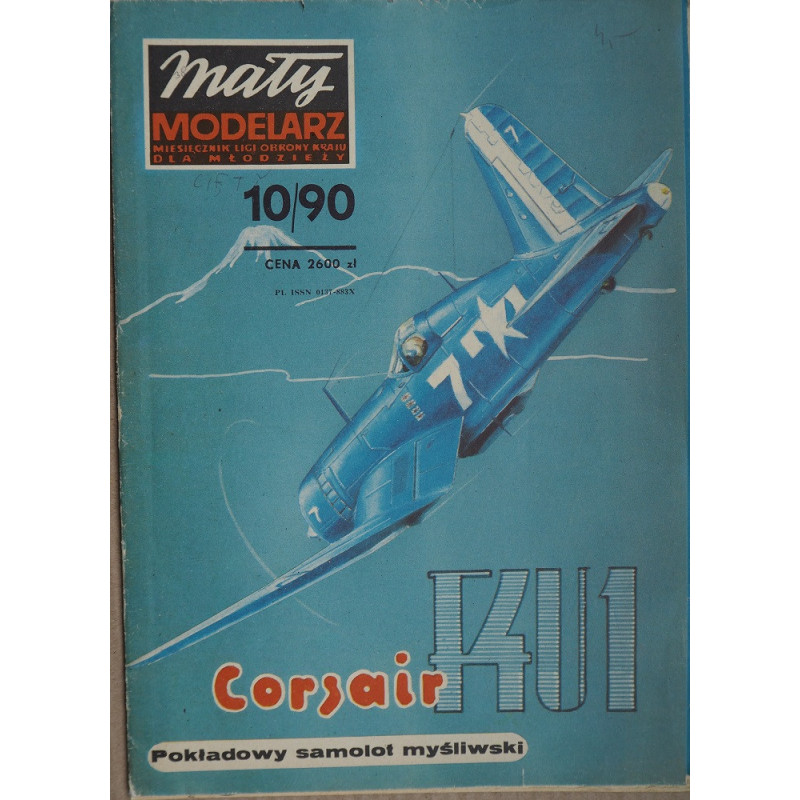


Publisher/ Manufacturer: "Maly Modelarz". Poland
Scale: 1 : 33
Number of sheets: 6 x A4
Number of sheets with details: 4
Number of assembly drawings: 11
Difficulty: For modelers of any experience.
Model dimensions: 302.5 mm x 378.5 mm x 139 mm
 Security policy
(edit with the Customer Reassurance module)
 Delivery policy
(edit with the Customer Reassurance module)
 Return policy
(edit with the Customer Reassurance module)
The revolutionary F4U “Corsair” design was developed in 1938 in response to a request from the US Navy for a high-speed fighter, that was to be based on aircraft carriers. “Chance Vought” took on the challenge of installing the most powerful available engines (Pratt-Whitney “Double Wasp”) into the smallest possible fuselage. The main thing was to fit the clumsy landing gear into the inverted, gull-wings, that became the aircraft's distinguishing feature. The first prototype flight took place on May 29, 1940, and the US Navy received the first serial production “Corsair” on July 31, 1942. However, tests conducted by the US Navy on aircraft carriers, revealed some design flaws, so the first series of aircraft entered the Marine Corps squadrons and were operated from land bases. The first unit, to receive the F-4, was VMF-124 squadron on Gudalcanal. It quickly became clear, that the new machine was undoubtedly superior to all enemy machines, and in some respects even to the F-6 “Hellcat”. However, at the same time, it was very difficult to pilot and required a lot of attention during landing. Interestingly, only up to 20% of the “Corsair's” missions took off from aircraft carrier decks, and for almost the entire war they remained mainly a Marine Corps fighter. After the end of World War II, the F-4 “Corsair” remained in service and participated in the Korean War (1950-1953).
A small model of a small fighter, quite well designed for those times and moderately detailed, intended for truly "small modelers". The entire exterior of the aircraft is not badly detailed, the cockpit equipment is not detailed, the landing gear is minimally detailed, its niches are also only minimally detailed, there are details of the hanging armament (two bombs). There are no color reserves, the textual instruction is considerable, quite detailed and informative in Polish, the graphical one is perhaps a bit too small, but sufficient for gluing the model. Antiquarian publication.

Publisher/ Manufacturer: "Maly Modelarz". Poland
Scale: 1 : 33
Number of sheets: 6 x A4
Number of sheets with details: 4
Number of assembly drawings: 11
Difficulty: For modelers of any experience.
Model dimensions: 302.5 mm x 378.5 mm x 139 mm