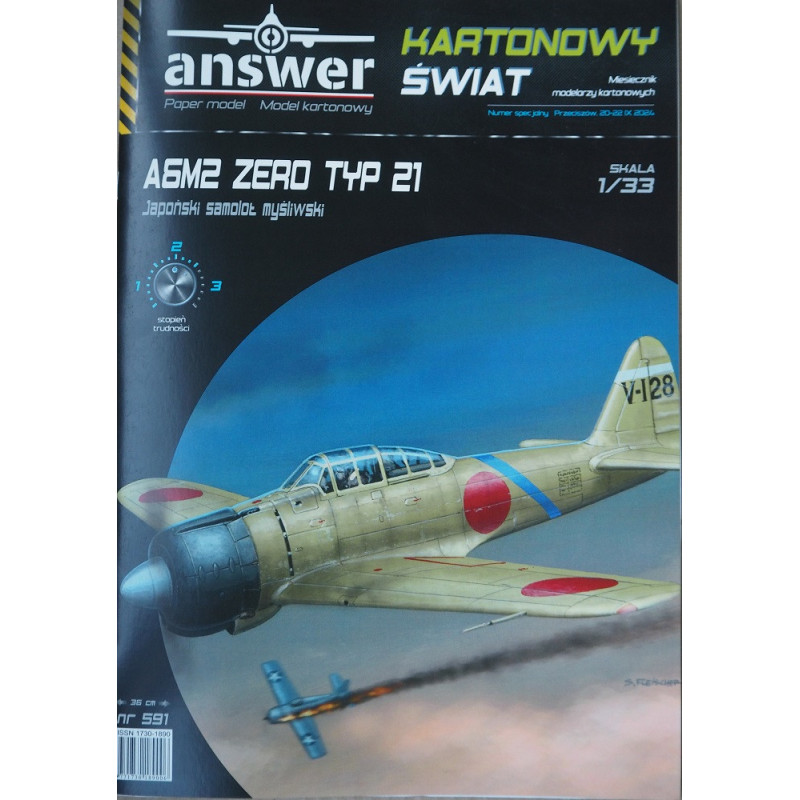


Publisher/ Manufacturer: "Answer" - "Kartonowy Swiat". Poland
Scale: 1 : 33
Number of sheets: 10 x B4
Number of sheets with details: 5 1/4
Number of assembly drawings: 41
Difficulty: For intermediate and advanced modelers.
Model dimensions: 274 mm x 363.5 mm x 106.5 mm
 Security policy
(edit with the Customer Reassurance module)
 Delivery policy
(edit with the Customer Reassurance module)
 Return policy
(edit with the Customer Reassurance module)
Mitsubishi A6M "Reisen", popularly known as "Zero" - the main fighter of the Imperial Japanese Navy of World War II, one of the best fighters at the beginning of the war. It was the world's first long-range escort fighter, which proved itself during the war in China before the start of the war in the Pacific. Also known as "Zeke" - the US code name for this aircraft. In Japan, the fighter had no official name, although it was often called "Reisen", which was an abbreviation of the designation Rei-shiki kanjo-sentoki (Fleet 0-type deck fighter). The number 0 represented the last digit of the calendar year (2600 in the Japanese calendar - 1940 in the Gregorian calendar) in which the aircraft was first produced. However, the most popular English translation of 0, "Zero", became so popular, that even in Japan it was often called "Zero-Sen". The fighter was designed by engineer Hiro Horikoshi in 1940. It was built in response to a Navy order to find a replacement for the aging A5M4 fighter. The order and requirements for the new carrier-based fighter were very beneficial for the company – maximum speed in horizontal flight – over 500 km/h, acceleration from the deck of the ship no longer than 70 m (Japanese aircraft carriers, due to their modular construction did not have catapults and the planes took off at their own power), the ability to fly at maximum engine speed for at least 1.5 hours, and a range of over 500 km. Fulfilling all these requirements was a difficult task, and an additional problem arose, because the Japanese designers, unlike their American colleagues, did not have a sufficiently powerful aircraft engine. As a result, armor and self-sealing fuel tanks were abandoned. A6M2 (model 21) – the main model, that entered the battle units of the Navy and aircraft carriers. They differed from the Model 11 in that, they had manually folding 0.5 m long wing tips, which reduced the space, occupied by the aircraft in the hangars. From the 128th exemplar, the massive aileron compensator was combined with the landing gear retraction mechanism, and from the 192nd exemplar, this panel was replaced by a new design panel, thus solving the problems with the ailerons. The “Mitsubishi’ factory produced 740, and “Nakajima” - 800 fighters of this model.
A complex, well-designed and excellently detailed model, which will suit only medium-experienced and experienced modelers. However, the version without cockpit equipment, with opaque cockpit glasses and retracted landing gear and with a simplified engine layout will be perfect for advanced beginners and modelers with little experience, working under the supervision of a more experienced colleague. Perfectly detailed fuselage, cockpit, landing gear, its niches, engine, all other external details. Standard Japanese IJN camouflage with quite pronounced traces of use. There are no color reserves. The textual instructions in Polish are small, but quite detailed and clearly explain the entire process of assembling the model. It perfectly complements the rather large and sufficient for good model assembly, informative and easy-to-read graphical instruction.

You might also like
Publisher/ Manufacturer: "Answer" - "Kartonowy Swiat". Poland
Scale: 1 : 33
Number of sheets: 10 x B4
Number of sheets with details: 5 1/4
Number of assembly drawings: 41
Difficulty: For intermediate and advanced modelers.
Model dimensions: 274 mm x 363.5 mm x 106.5 mm