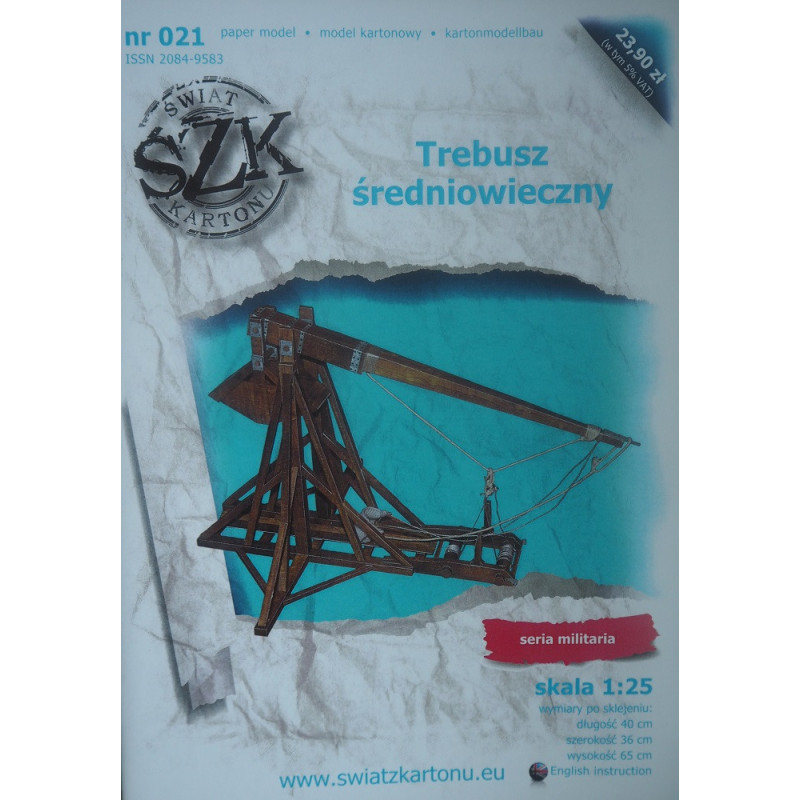


Publisher/ Manufacturer: "Swiat z Kartonu". Poland
Scale: 1 : 25
Number of sheets: 10 x A4
Number of sheets with details: 8 1/2
Number of assembly drawings: 5
Difficulty: For modelers of any experience.
Model dimensions: 400 mm x 360 mm x 650 mm
 Security policy
(edit with the Customer Reassurance module)
 Delivery policy
(edit with the Customer Reassurance module)
 Return policy
(edit with the Customer Reassurance module)
In medieval Europe, siege warfare was one of the most important elements of warfare (especially in the Middle and Late Middle Ages), and the art of besieging castles or fortified points was very important. Given this, it is not surprising, that many different types of siege machines appeared in medieval Europe. Of course, one of the most common was the battering ram, which was supposed to overturn walls or – much more often – break down the gates of a besieged fortress. Various catapults were also used, including such machines as: mangonels, onagers or trebuchets (trebukas). The last off them appeared in the battles of the Mediterranean in the XIIth century and quite quickly found their way to other European countries. It used a counterweight to balance the weight of the thrown load. It was also considered one of the most effective siege machines of the Middle Ages. When writing about throwing weapons, it is worth mentioning the great crossbows, that appeared in the High Middle Ages. Of course, siege towers were also widely used.
A large, well-designed and not overloaded with details model of medium complexity, which will be perfect even for advanced beginners and modelers with little experience. Only they should work under the supervision of a more experienced colleague, don’t rush, work carefully and attentively. Since the graphical instruction is only as much, as the "cat cried", it will be very problematic to cope with the cable control system of this formidable weapon. To properly guide her, You may have to look for information on the Internet, as what is given in the edition, is not very informative and leaves a lot of room for guesswork. The textual instruction also do not provide much clarity in this area. There are no reserves of colors and textures.

Publisher/ Manufacturer: "Swiat z Kartonu". Poland
Scale: 1 : 25
Number of sheets: 10 x A4
Number of sheets with details: 8 1/2
Number of assembly drawings: 5
Difficulty: For modelers of any experience.
Model dimensions: 400 mm x 360 mm x 650 mm