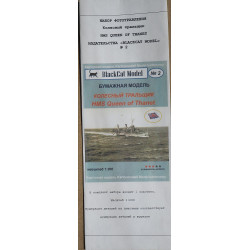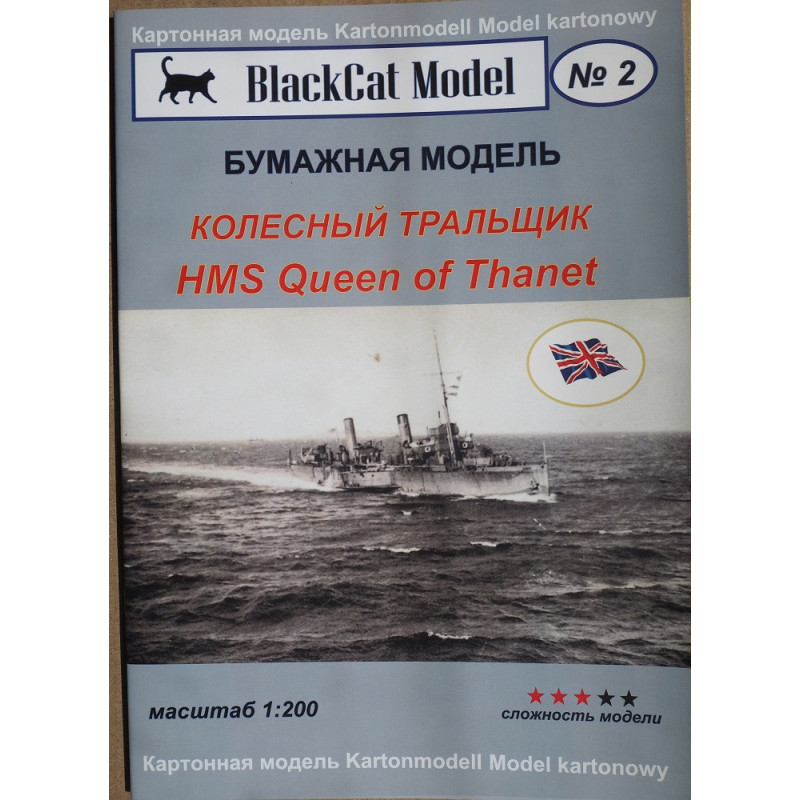


Manufacturer/ Publisher: "Black Cat Model". Belarus
Scale: 1 : 200
Number of sheets: 12 x A4
Number of sheets with details: 7 1/2
Number of assembly drawings: 61
Difficulty: For modelers of any experience
Model dimensions: 360 mm x 90 mm x 123 mm
 Security policy
(edit with the Customer Reassurance module)
 Delivery policy
(edit with the Customer Reassurance module)
 Return policy
(edit with the Customer Reassurance module)
The „Rececourse”-class minesweepers are a type of wheeled minesweeper, built according to two very similar designs during the First World War under the “Emergency War Program” for the British Royal Navy. A total of 24 ships of the original project and 8 of the “Modified Recacourse” project were built. All of these ships are also known as „Ascot”-type minesweepers. HMS “Queen of Thanet” entered service in March 1916 and was named HMS “Melton”. The ship was built at the “William Hamilton and Company” shipyard in Glasgow. The ship could have carried two seaplanes from the very beginning of her service, but this was never done during her entire service. Throughout her service in the First World War the ship served on the Auxiliary Patrol, after the war he was included in the Minesweeper Force. In 1929 HMS “Melton” was renamed “Queen of Thanet” and converted into an excursion steamer for cruises on the Thames and Medusa. For the next 12 years the ship was a frequent guest in the region from Sheerness to Southend, regular excursions were made to Gravesend, Margate, Clacton and Dover, and also occasionally made routes to Calais, Dunkirk and Boulogne. In 1939 the ship was requisitioned by the Admiralty and re-entered military service for its original purpose. In May 1940 he actively participated in the Dunkirk evacuation, taking out more than 4,000 soldiers in 4 trips. Half of them were rescued from the ship "Prague", which was severely damaged by attacking German dive bombers and the ship sank. After the war the ship was returned to its former owner and resumed excursion trips in the Thames Estuary. In 1951 during a repair in dock, a fire broke out on the ship, which destroyed it. The remains were given for cutting.
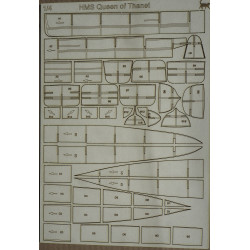
An interesting model of medium complexity, well-designed and richly detailed, suitable for modelers of any experience, except for complete beginners. Advanced beginners and modelers with little experience are recommended to work under the supervision of a more experienced colleague, don’t rush, work carefully and accurately, some things can be simplified. The model reproduces all the details of the ship's exterior, quite realistic and pleasing to the eye textures of wooden decks, simple ship rangout and rigging. Where necessary, double-side printing was used, there are no color reserves. The textual instruction in Russian is small and only general provisions. The graphical instruction is quite extensive and perfectly explain the entire gluing process, only the render-type drawings lack clarity and separation of detail boundaries.
You might also like
Manufacturer/ Publisher: "Black Cat Model". Belarus
Scale: 1 : 200
Number of sheets: 12 x A4
Number of sheets with details: 7 1/2
Number of assembly drawings: 61
Difficulty: For modelers of any experience
Model dimensions: 360 mm x 90 mm x 123 mm