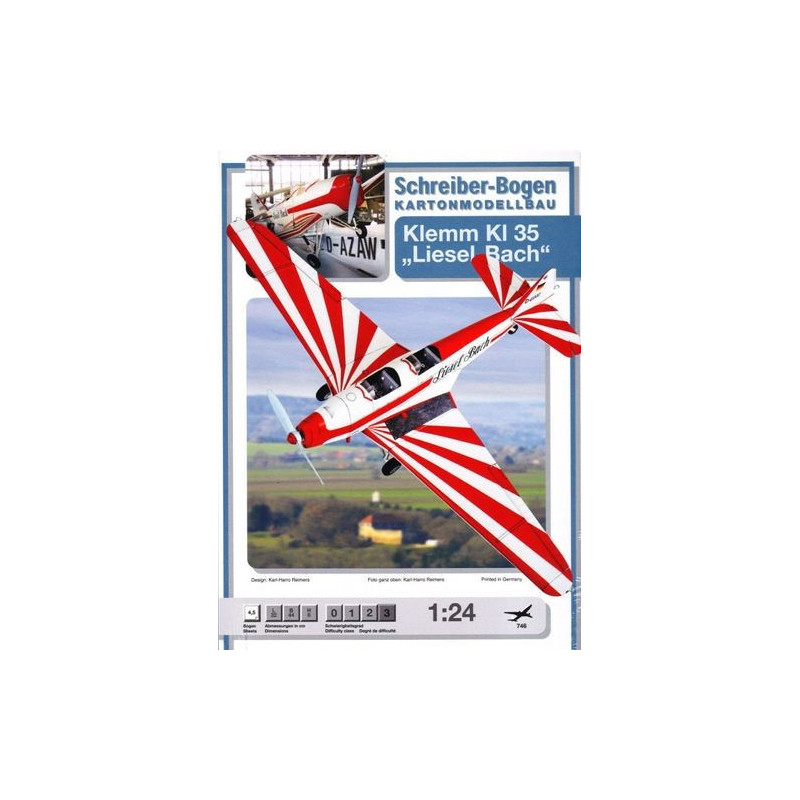


Publisher/ manufacturer: "Schreiber-Boggen". Germany
Scale: 1 : 24
Number of sheets: 10 x A4 (1 sheet of 1 mm cardboard)
Number of pages with details: 5
Number of assembly drawings: 32
Difficulty: For modelers of any experience
Model dimensions: 312.5 mm x 433.5 mm x 85.5 mm
 Security policy
(edit with the Customer Reassurance module)
 Delivery policy
(edit with the Customer Reassurance module)
 Return policy
(edit with the Customer Reassurance module)
Perfectly suited for aerobatic flying, it was first publicly demonstrated at the international aviation festival in Mediolan in 1935 and quickly found many buyers. The air forces of many countries (Romania, Hungary) purchased these planes for pilot training. Sweden at least 5 examples were seaplane versions. Despite this interest, plans for license production of the Klemm Kl-35 abroad were not destined to come to fruition. The Kl 35 was designed in 1934 under the auspices of the Reichsluftfahrtministerium (RLM). Graduated engineer Fridrich Fecher was in charge of production. The so-called Gemischtbauweise construction was used: the fuselage was of steel construction, the tail-plates and wing construction were of wood, and only a small amount of light alloys were used in the production of these aircraft. This was the traditional RLM aircraft construction method of the time, relying on the material resources, available in their own country. The results of the tests must have been satisfactory, because already in July 1936, a batch of 23 aircraft was ordered, which had to be delivered by July and September 1937. At that time, the "Klemm" company was busy with the production of the FW-44 under the license of Focke-Wulf. At that time, the RLM was already looking for contractors for the production of the Kl-35A, from which the firm Fieseler was chosen, which already produced the Heinkel He-72 and Focke-Wulf FW-58, in addition to its own production at the "Storch" in factory in Kaseler. Later, another 1,386 units of the new version of the Kl-35B aircraft with a new engine were ordered. Production at the "Fieseler" company ended in November 1939, after 365 aircraft were produced, according to the order of the RLM, they began production at the "Zlin" factory in occupied Czechoslovakia. Having purchased one plane (Taylor "Cub"), the "Šaulių sąjunga' aviation, concerned about purchasing more aviation equipment, announced a donation drive for the purchase of planes. When enough money accumulated in the donation fund, a Klemm Kl-35b aircraft, suitable for training and high flying, was purchased in Germany. In 1938 December 1 he was flown to Kaunas by av. Lt. L. Lendraitis and av. capt. A. Krasnickas-Audronis. The plane is named "Sakalas 2" by šauliai. According to other data, three planes of this type were purchased in 1939 in the spring, about 117,000 litas were collected from the range šauliai and supporters, with which two more Klemm Kl-35b planes were bought. They cost 70,000 litas each. They were flown to Kaunas by av. Lt. J.Andriušis and av. Lt. L. Lendraitis. On June 25, in commemoration of the 20th anniversary of the founding of the Rifle Association (Šaulių Sąjunga), both of these planes were christened "Sakalas 3" and "Sakalas 4" at the Kaunas airport. Like other "Sakalas", the marks of the Rifle Union were painted on the lower sides of the wings and on the steering wheels - white Vytis crosses on a red shield. The prototype of the plane was built in 1935. There were sleek aerodynamic shapes, nimble and submissive in the air. Considered one of the most modern and popular sport planes of its time. Built in large series. Used for training purposes until the end of World War II.
A large-scale, simple, well-detailed model, painted almost in the colors of the Lituanian "Šaulių sąjunga". Perfect for a modeler of any experience, only advanced beginners and less experienced modelers should stick this model under the supervision of a more experienced colleague.

Publisher/ manufacturer: "Schreiber-Boggen". Germany
Scale: 1 : 24
Number of sheets: 10 x A4 (1 sheet of 1 mm cardboard)
Number of pages with details: 5
Number of assembly drawings: 32
Difficulty: For modelers of any experience
Model dimensions: 312.5 mm x 433.5 mm x 85.5 mm