- New
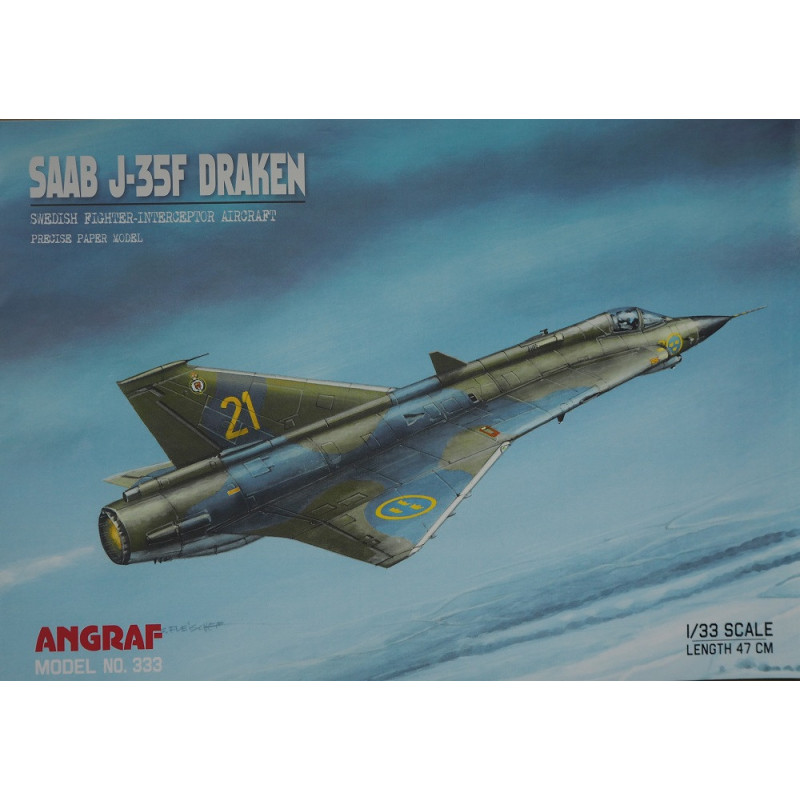


Publisher/ Manufacturer: “Answer” – “Angraf”. Poland
Scale: 1 : 33
Number of sheets: 13 x A3
Number of sheets with details: 7
Number of assembly drawings: 71
Difficulty: For intermediate to advanced modelers.
Model dimensions: 465 mm x 285 mm x 118 mm
 Security policy
(edit with the Customer Reassurance module)
 Delivery policy
(edit with the Customer Reassurance module)
 Return policy
(edit with the Customer Reassurance module)
The SAAB J35F “Draken” was a jet fighter of the Swedish Air Force. With the commercialization of jet bombers in the 1940s, intercepting high-speed bombers became a challenge. The Swedish Air Force was no exception and in 1949 began developing a supersonic fighter-interceptor. The specifications provided specific Swedish requirements, such as short take-off and landing (STOL) characteristics, that would allow the aircraft to take off and land on a 2,000-meter highway, that could be used as an emergency runway, as well as the ability to re-arm and refuel within 10 minutes. An unprecedented double delta wing was used to meet these high requirements. After several demonstrations, using a small SAAB 210 test aircraft, the prototype made its first flight in 1955. Named "Draken" (Swedish for "dragon"), the J35 entered service in the Swedish Air Force in 1960. The “Draken” achieved several groundbreaking records: in 1960 it became the first Western European fighter to reach Mach 2. It was also the first fighter to perform the Cobra maneuver. Its appearance was unique and advanced, and it is said to have pioneered the delta wing and mixed wing – fuselage construction. The “Draken” was originally designed as a fighter, but due to its high performance, it was used for many functions. As a result, many variants emerged, of which the F was a fighter variant with improved avionics and an infrared seeker, reducing the number of cannons to one. 615 “Drakens” were built, some of which were exported to Finland, Austria, Denmark and other countries. Although the “Draken” was popular for its distinctive appearance, the last one was retired by the Swedish Air Force in 1999.
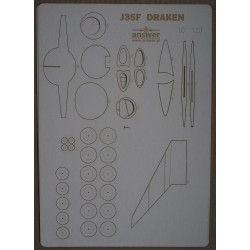
A small and well-designed, highly detailed model of a small fighter, of medium complexity, painted in the Swedish Air Force camouflage. The model is suitable only for intermediate and experienced modelers. This is mainly due to the rather complex shape of the aircraft. The model perfectly reproduces all visible exterior details, the chassis, its niches, the cabin equipment, the control surfaces are only separated from the main surfaces, the outboard armament (and there is quite a lot of it) is perfectly reproduced. There are a lot of colors reserves, the textual instruction in Polish are small - only a few general notes. The graphical instruction is considerable, well drawn, informative and easy to read.

You might also like
Publisher/ Manufacturer: “Answer” – “Angraf”. Poland
Scale: 1 : 33
Number of sheets: 13 x A3
Number of sheets with details: 7
Number of assembly drawings: 71
Difficulty: For intermediate to advanced modelers.
Model dimensions: 465 mm x 285 mm x 118 mm